Porous structures in additive manufacturing make it possible to integrate permeability, filtration and fluid transport directly into metal components. Instead of treating porosity as a manufacturing defect, it can be deliberately engineered as a functional material property.
With Laser Powder Bed Fusion, porous regions can be produced locally within an otherwise dense component. Dense mounting points, sealing surfaces and structural sections can therefore be combined with permeable functional areas in a single manufacturing process.
Functions of Additively Manufactured Porous Structures
Depending on the material, porosity level and pore network, additively manufactured porous structures can provide functions such as:
- controlled permeability for gases and liquids,
- filtration and particle separation,
- venting and pressure equalisation,
- passive fluid distribution,
- condensate and moisture management,
- evaporative cooling,
- capillary liquid transport.
Because the porous region is integrated directly into the component, separate filters, inserts, seals and assembly steps may be reduced or eliminated. This enables a higher level of functional integration and can simplify the overall system design.
Engineered Porosity Through LPBF Process Development
The performance of a porous metal structure depends strongly on the interaction between material, component geometry and manufacturing process. The resulting pore size, open porosity and connectivity of the pore network must therefore be adapted to the intended function.
Producing a functional porous structure requires more than creating an increased level of porosity. The structure must provide the required permeability, mechanical stability and reproducibility. Experimental testing is essential to connect the resulting pore structure with the functional performance of the component.
Practical Example: Capillary Fluid Transport
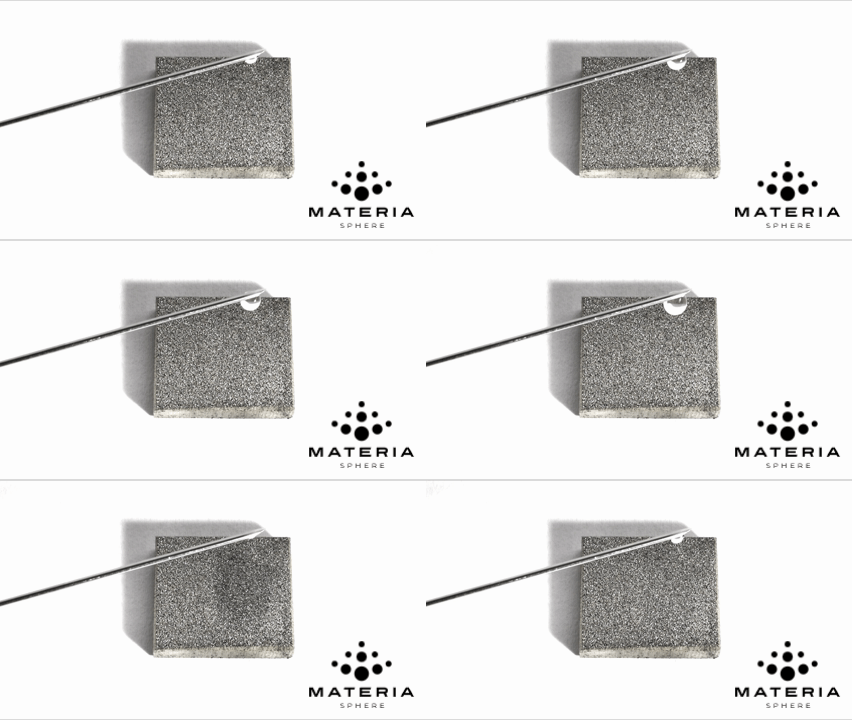
To demonstrate the potential of functional porosity, MATERIA produced a porous steel test specimen with an interconnected pore structure.
Operating Principle
When a water droplet comes into contact with the surface, capillary forces draw the liquid into the connected pore network. The fluid is then transported and distributed through the porous region without pumps, pressure systems or any other external energy input.
The accompanying animation shows how the water droplet is gradually absorbed by the test specimen. This demonstrates how an additively manufactured porous structure can act as a passive transport medium for liquids.
The resulting behaviour depends on factors such as pore connectivity, pore size, surface condition, material properties and the characteristics of the respective fluid.
Potential applications include:
- passive liquid distribution and drainage,
- condensate management,
- evaporative cooling,
- thermal insulation.
Integrating Porous and Dense Regions in One Component
A key advantage of additive manufacturing is the ability to combine porous and dense regions within a single component.
The porous structure can be positioned only where liquid transport, permeability or moisture management is required, while the remaining areas retain dense structural, mounting or sealing functions. This makes it possible to integrate the porous functionality directly into a larger component instead of adding a separate insert or filter element.
Such integrated designs can reduce interfaces, seals and assembly steps while enabling highly application-specific fluid paths. Porous functionality can therefore be added locally without compromising the structural requirements of the surrounding component.
Design and Process Development Must Work Together
Functional porous components require a coordinated approach involving design, material selection, process development and testing.
The component geometry determines where the porous function is required. The manufacturing process determines the structure that is created. Experimental validation then verifies whether the component achieves the required permeability, capillary behaviour and mechanical performance.
At MATERIA, we support the development of integrated porous structures across the complete process chain. This includes defining the functional requirements, designing the component, developing suitable LPBF processes, manufacturing prototypes and evaluating their performance.
By combining dense and porous regions in a single component, additive manufacturing transforms porosity into a deliberately engineered function.
