Additive Manufacturing for High-Performance Electric Motors
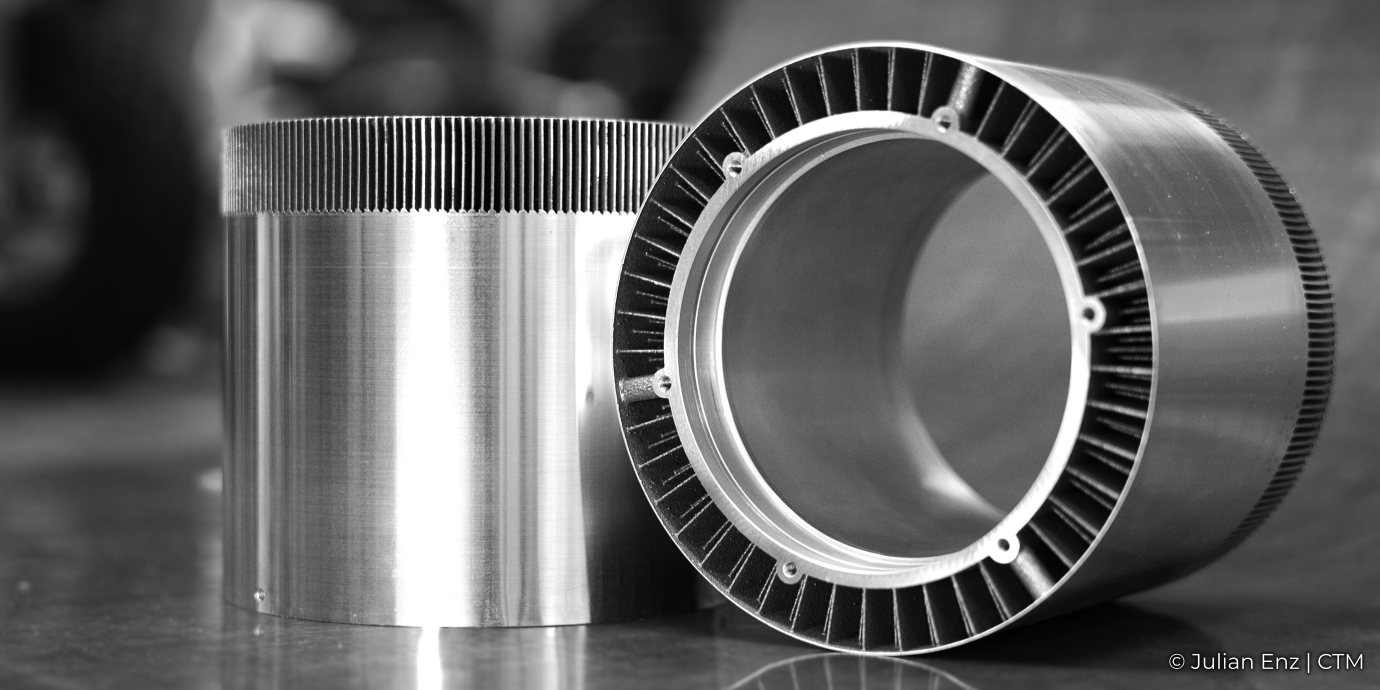
For this year’s race car of Campus Tirol Motorsport (CTM), a highly integrated electric motor housing was developed and manufactured using Laser Powder Bed Fusion (LPBF). The design was created by the CTM Formula Student Team, while MonaLab and MATERIA were responsible for process optimization and additive manufacturing.
This project demonstrates how additive manufacturing enables the development of highly functional components and unlocks new possibilities in lightweight design, thermal management, and functional integration.
Integrated Air Cooling Instead of Conventional Cooling Systems
The motor housing was designed for an electric motor delivering 35 kW peak power and 30 Nm peak torque. Under continuous high-load operation, efficient thermal management is essential to ensure reliable performance.
Instead of relying on a conventional liquid-based cooling system, air cooling was integrated directly into the component geometry. Thin cooling fins with wall thicknesses down to 0.50 mm maximize the heat transfer surface while maintaining a lightweight and structurally efficient design.
By integrating the cooling function directly into the part, the overall number of components and assembly effort can also be significantly reduced.
Manufacturing Using Laser Powder Bed Fusion (LPBF)
The motor housing was manufactured from AlSi10Mg using the LPBF process and achieves a weight of only approximately 580 g, despite its high level of functional integration.
Producing these fine cooling structures places high demands on the manufacturing process. Thin-walled geometries and high aspect ratios require carefully optimized process parameters and scan strategies to ensure stable, repeatable production and consistent part quality.
Optimized exposure strategies not only improve process reliability but also offer potential for reducing build times, making the manufacturing process more efficient.
Additive Manufacturing as an Enabler for Functional Integration
This project highlights that additive manufacturing is far more than a technology for producing complex geometries. It enables multiple functions—such as cooling, lightweight design, and structural performance—to be integrated into a single component, resulting in lighter, more efficient, and higher-performing products.
Applications extend far beyond Formula Student, offering significant benefits for industries such as e-mobility, mechanical engineering, automotive, and aerospace, where performance, weight, and functional integration are key design drivers.
The motor housing developed together with Campus Tirol Motorsport demonstrates how innovative engineering and optimized additive manufacturing can be combined to fully exploit the potential of Laser Powder Bed Fusion.